Kathy Freeman Company | Executive Search | Investment Industry

Executive Search & Human Capital Consulting for Financial Services

  • Home
  • Firm
  • Searches
  • Insight
  • Contact

Talent Strategies for an Uncertain Time: Timely Insights Field-Tested by Senior Leadership

Kathy Freeman Godfrey April 13, 2022

I recently had the opportunity to connect with senior leaders from the investment industry to discuss human capital. In a large group forum, we addressed the extraordinary challenges firms are facing as a result of the Great Resignation, along with the difficulty of reintegrating and engaging people back to the office after two years of remote work. The criticality of the topic led to a dynamic and exceptionally productive conversation.

It was great to hear that many firms have refreshed their leadership playbooks to develop new and creative solutions to engage and retain talent. The dialogue was so compelling that I wanted to share several of their insights to encourage change, where merited. We had polled many of these same leaders in Q4 2021 on similar issues, and those findings are published in our 2021 Talent Trends Report.

#1: Increasing Transparency is Driving Leadership Change

Becoming an attractive destination for great talent in an increasingly transparent world means firms are under pressure to rid themselves of toxic leadership. It’s no longer a secret if a management team is perceived poorly. Glassdoor.com and many other sites rate a firm’s management and culture in real time. With many firms struggling to attract and retain talent, no one can afford multiple negative reviews nor the slide toward a poor reputation. Winning firms are being more decisive and less tolerant of leaders who don’t build out the skills and abilities of their teams in a positive manner.

Firms motivated to enhance their reputation to attract talent are investing in more constructive leadership programs. One idea mentioned in our leadership forum was an internal advocacy program to connect Next Gen talent with senior leaders. This is highly effective. Mentorship and exposure to senior leaders sends a strong message that up-and-coming talent is valued and that their leaders are champions of their success. Leaders who promote candid dialogue, offer guidance during difficult career decisions, or help individuals navigate complex conversations, are well-received by employees. These conversations can travel beyond the four walls of your organization and enhance your brand.

Leaders keen on focusing on the vital human dynamic lost or damaged during two years of remote work are also instituting “buddy programs” for new hires. These programs typically work by pairing a new hire with an existing employee who can show them the ins-and-outs of the company. The new person will have a much better opportunity to understand and integrate into a company’s culture, their political landscape, and be included in social activity or dialogues with the help of a firm veteran.

#2: In the Midst of a Talent Shortage, Firms are Being Intentional to Highlight Internal Opportunities

Firms successful in talent development and recruitment today are helping their people realize what opportunity exists at their own firm, rather than watching them walk out the door. These firms encourage career and personal growth by fostering exploration within their company. By contrast, firms that don’t open doors elsewhere in their firm, even for their best performers, risk losing these employees altogether.

Another facet of the same idea is internal “internships.” Some firms have created a path for an employee to shadow other employees to get a better feel for different functions and divisions within the business. Allowing people to gain greater clarity about the work performed by other parts of the business can lead to cross-pollination of talent. Even more importantly, it can create a greater understanding of each department’s contribution to the company’s mission and success. Internal internships are being leveraged as a tool to help retain employees. This approach can be another selling point in employee recruitment efforts as well.

#3: Enhancing Employee Engagement Requires More Interactive Communication from Leaders

To facilitate transparency, empathy and engagement in field-based sales organizations, some leaders have initiated “Listening Tours.” These internal roadshows allow leaders to engage with small groups of employees in different geographies to solicit their feedback on a variety of topics. The goal of these candid conversations over several months is employee-inspired action plans that can be deployed in various ways. Not only does this kind of active listening foster positive change, but it also motivates teams to buy in to the implementation of the proposed ideas.

While most firms are bringing their employees back to the office on a hybrid schedule, there’s an opportunity to complement these face-to-face meetings with other more personal engagement. To strengthen a firm’s social fabric and create collegiality, some leaders have been creating a team newsletter online to discuss hobbies, children, vacations, sports, March Madness picks or Fantasy Football teams. Posting pictures akin to an Instagram feed are avenues for building connectivity specific to a team or business unit.

The Bottom Line

As the Great Resignation continues, it was encouraging to hear these industry leaders have pivoted and built defensive strategies to retain and develop their talent. The labor shortage, which isn’t going away any time soon, has demanded that leaders step up their game. They need to focus on team building and engagement to be an attractive destination for the limited talent that’s available. It was rewarding to facilitate a conversation in which leaders shared their strategies for intentionally rebuilding their own tool kits and investing in their people. The dialogue was also clear evidence that this engagement and sharing of best practices is what has been missing from Zoom calls over the past two years!


Turnover is Accelerating: Three Trends Behind the Talent Shift in Financial Services

Kathy Freeman Godfrey June 24, 2021


The financial services industry is undergoing a seismic demographic shift accelerated by the pandemic. An industry filled with aging Baby Boomer leaders and financial advisors is now experiencing a wave of retirements and culture-induced departures to other firms. As noted in a recent Wall Street Journal article, there’s a national trend of workers leaving their jobs for various reasons including better opportunities and a better work-life balance.

We’ve seen three recurring trends impacting turnover in the financial services industry:

#1 The desire for a better work culture and hybrid work arrangement.

Getting executives and their teams back to the offices is essential, but there is also a desire by many to continue working remotely in some capacity. Not all companies are on board with this. For example, Morgan Stanley’s CEO, James Gorman, recently said, “If you can go to a restaurant in New York City, you can come into the office, and we want you in the office…if you want to get paid New York rates, you work in New York,” he noted. He went on to say, “None of this, ‘I’m in Colorado, and getting paid like I’m sitting in New York City.’ Sorry, that doesn’t work.”

A CEO with this attitude may soon find his colleagues heading to companies who are embracing hybrid or remote work environments. For many, working for a company whose leadership listens to their employees, especially with regard to culture and remote flexibility, has become a driver of career satisfaction. Today, in the absence of a flexible corporate policy, companies might as well open their exit doors and prepare for departures.

#2 The retirement of Boomers.

At the start of the pandemic, many Boomers put their retirement on hold. Now that the crisis is waning, people are fast-forwarding their previously planned exit strategies. A few notable retirements include Kathleen Murphy of Fidelity Investments and Barbara Novick of Blackrock, two top-level industry leaders.

The pandemic has allowed many executives to work from their second homes at the Cape, on the beach, or in the mountains. Some were reminded that life is short and expedited their retirement over health concerns. Others are prioritizing time spent with their families, hobbies, or volunteerism. The idea of going back to the full-time daily grind in the office has become unappealing for many.

Meanwhile, succession planning across the industry is in full swing. The silver lining in these retirements is that many roles are now opening up for next generation leaders. This generational shift will certainly be bringing fresh ideas and new thinking to a mature industry.

#3 The re-prioritization of staffing expenses.

Many companies are re-prioritizing their staffing expenses, which is a unique byproduct of the pandemic. Many companies have been proactively reducing headcount at senior levels to reduce payroll liability while simultaneously adding jobs at entry, junior, and mid-career levels. TIAA and Fidelity Investments are two major asset management companies that have offered early, and well-paying, retirement packages to many senior staff. Charles Schwab has also been in the headlines for reducing their headcount after acquiring TD Ameritrade yet aggressively hiring for their retail investor business.

For those who took a generous early retirement package and are looking for their next gig, there should be ample opportunities to get realigned with another company given today’s markets.

***

The most noteworthy takeaway coming out of the pandemic is for companies to lead with empathy. Companies who do so will stem the tide of turnover and provide an attractive landing spot to people who are disenfranchised with their current company’s culture or work environment.

Pandemic’s Impact On Human Capital & Executive Search At Family Offices, RIAs

Kathy Freeman Godfrey June 16, 2020


This commentary was published on June 12th, 2020 in Family Wealth Report.

The pandemic has forced leaders to reflect and modify their talent acquisition process and to prioritize retention. The author of this article drills into how COVID-19 affects multi-family offices and registered investment advisors.

Kathy Freeman Godfrey is president of Kathy Freeman Company, a national executive search firm working with multi-family offices and wealth management firms.

***

The COVID-19 pandemic has not only upended the financial markets, but it has also changed how family offices and RIAs will need to think through recruiting and managing talent in the months to come.

The pandemic has forced leaders to reflect and modify their talent acquisition process and to prioritize retention. The coronavirus has also prompted a discussion about what a firm’s future might look like given the health threat to the baby boomers who are leading many of these businesses.

Here are five key talent and executive search trends family offices and RIAs need to consider:

Succession planning has taken on increased importance.

COVID-19 has been a wake-up call for chief executives of multi-family offices and RIAs. Long considered an administrative chore, succession planning has risen to the top of the agenda because the pandemic has highlighted a number of strategic issues.

These include whether the firm has a viable strategy for long-term sustainability and whether that path leads it to remain independent or to sell.

As a result, CEOs have started thinking seriously about hiring a chief operating officer or a second-in-command. COVID-19 has swamped many CEOs with operational issues they should not, and prefer not, to handle. Professionalizing the leadership team by ensuring that the firm has a multi-dimensional and cross-talented leadership bench will support these seasoned leaders whether they choose to build a legacy organically or prefer M&A forlong-term growth.

Sophisticated client advisors and wealth strategists are in limited supply.

Client-facing talent is always in short supply, but even more so now. The complexity of working with the ultra-high net worth requires a much higher degree of technical competence than ever before.

Today, the CFP designation isn’t enough. Private client advisors and wealth strategists often have numerous advanced degrees or designations such as JDs, CPAs, LLMs, or CFAs. Professionals with this kind of advanced or niche expertise and accomplishments are in high demand. Beyond the technical competence, there’s a need to layer in a strong degree of EQ (emotional intelligence) to navigate conversations about complex issues with families and their heirs.

The interview timeline has been extended.

What used to be a fairly quick process for candidate interviews has now been stretching into months.Firms are integrating Zoom or Microsoft Teams to conduct video interviews, which has served as a good middle step for getting acquainted with potential candidates. However, with the importance of each and every hire, staffing decisions for critical roles are being postponed until face-to-face meetings can resume.

Employee retention efforts have become increasingly important.

Firms may be unaware that the downside to having employees working remotely is that there is a greater ability and willingness to take calls from search firms or recruiters. Management teams need to prioritize the engagement of talent, especially when we are living in this disconnected time.

If a firm is experiencing difficulties because of the pandemic, whether it is a liquidity issue or their inability to offer a compelling vision for the future, employees will sense these weaknesses and be more open to conversations from other firms.

Working remotely will impact the cultural paradigm of every firm.

This new remote working environment due to the pandemic is a unique opportunity to address work-life balance and strengthen employee loyalty.

Many employees have realized that they can be quite productive without water cooler distractions or lengthy daily commutes. However, other employees have dealt with tremendous challenges whether trying to teach their school-aged children or take care of their elderly parents all while trying to productively address their work responsibilities.

When firms begin to ask their employees back to the office, it needs to be done with an attention to retaining the best of the company’s culture, while allowing flexibility of working between home and office. Figuring out the best way to maintain a culture of growth, trust, and client excellence without the consistent office camaraderie is going to be a challenge which firms will need to address.

© Copyright 2020 ClearView Financial Media Ltd, 52 Grosvenor Gardens, London, SW1W 0AU, UK Tel: +44 (0) 207 148 0188 • info@clearviewpublishing.com • www.clearviewpublishing.com VAT Reg No: 843 3686 09 • Registered in England: 067841312

Gauging Your Own Professional Health – Time to Dig In or Pivot?

Kathy Freeman Godfrey December 12, 2019

Year end is a perfect time to reflect on your career.

Whether you are an individual contributor or in executive leadership, everyone struggles a bit to keep up with or stay ahead of the changes in the investment industry. One key takeaway from the hundreds of interviews we conducted this year is that some are happily evolving as the industry changes, while others are not enjoying themselves as much as they did.

My recommendation, for your “professional health,” is to make the time at year end to reflect on the work you are doing, who you are doing it for, and who you are working with. Then assess your satisfaction.

Understanding Yourself

In our interview assessments, we walk candidates through a series of questions many haven’t thought about in years. I wanted to share some basic but important questions for your consideration. Hopefully, you’ll create a better foundation from which to make future career decisions.

#1: Passion – What Do You Really Love About What You Do?

Your answer is exceptionally telling. Do you enjoy working directly with clients to solve their critical challenges? Do you enjoy working with a particular client segment? Do you enjoy building new businesses from scratch? Do you enjoy training and developing others? Are you the most energized in strategic roles or more tactical roles?

Take a moment to gauge your current passion for what you are doing. If it’s not high, consider the changes you need to make. Life is too short to spend time somewhere or doing something that doesn’t make you happy.

#2: Create Your Ideal Position Description.

This is a great exercise to step back from what you know and what you do each day. Consider the world from just your lens. Compare and contrast your existing role and firm to your ideal role and firm. Be sure to consider the responsibilities you enjoy most, the challenges you’d like to take on, and any new products or services you’d like to learn or represent in the market.

The investment industry is rapidly changing, which means people’s roles and firms are often in flux. Perhaps your responsibilities have increased, while others have been laid off. Although it’s good to be employed, if your workload is so great that other areas of your life are suffering, then something needs to change. Perhaps you don’t have a voice at the strategic table or it is being stifled. Or perhaps your firm isn’t innovating as quickly as other firms which is affecting your energy to champion your products or services. Considering the world from your ideal lens means asking tough questions of yourself, as well as reflecting on whether your company, its vision, and its trajectory are meeting your needs.

#3: Performance Matters. Be Aware of Your Own Bar And Pivot Your Career Accordingly.

It’s important that you have your own standards and are cognizant of where you are performing against your own bar. Since firms can, at times, set unrealistic expectations, it’s critical to have your personal benchmark to regularly reflect on your performance.

A good question to ask is how your performance measures up to those in a similar role. Are you differentiating yourself in any way? If so, how? If you don’t know or don’t care how you differentiate yourself from your colleagues, then you may be in jeopardy when layoffs occur. If you are underperforming, which happens to everyone at some time or another, then think through if there is a developmental opportunity you can identify to support your success. Don’t wait for someone to point out your failings. If you are exceeding against your own bar or your peers’, is there more you can do with your capabilities? Can you help others on your team achieve at a higher level? Would you like to be considered for a stretch assignment at your firm? Speak up! In preparation of stepping up, make the time to consider who you can train and pull up behind you to take your place.

Being self-aware is critical in this exercise. Identify your own performance benchmarks and where you measure on the scale. If you think you are exceeding your own expectations, congratulations! Now you can think more deeply about how you can be challenged further. If you have had a difficult year and aren’t quite where you’d like to be, consider what resources you need to achieve excellence again.

What’s Next?

Assessing your professional health is always a worthwhile endeavor, whether it is the end of the year or any time in between. If you feel like you have room to do more, commit to what “more” looks like and how to get there. If you’d like to do better, what are steps you can take toward improvement? If you’d like to do less, consider another role or firm that gives you that latitude.

Unemployment is at an all-time low. Great people are in short supply. Don’t settle for being less than happy. Pivot onto a better track.

Talent, Not Technology, Still Carries the Day in the Investment Industry

Kathy Freeman Godfrey July 10, 2017

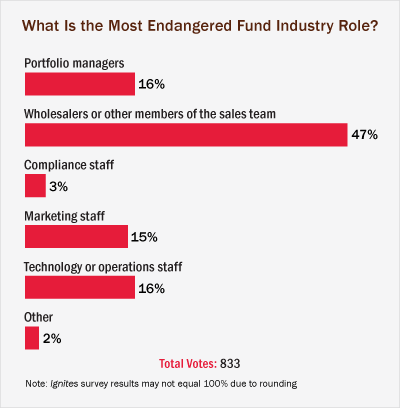
A recent survey of Ignites readers concluded that sales and marketing professionals are quickly headed for extinction due to technology, but is that really the case?

The short answer: No way.

The argument that technology will replace talent is a stretch at best. Sure, technology brings efficiencies, but that’s been happening for the past 100 years. At the end of the day, talent always trumps technology. What was the last great company that had terrific technology, but little or no sales and marketing expertise?

In my work in executive search across the investment industry, I see every day that having top sales and marketing talent on your team has never been more important. If anything, there is a talent shortage for world-class sales and marketing executives, and that dearth of talent is holding back many companies with hockey-stick like revenue plans.

Don’t Call the Undertaker

Rumors about the demise of sales and marketing talent in the investment industry are greatly exaggerated for several reasons.

First, great firms and great teams are the direct result of great people. Think about the impact that Jim Jessee or Carol Geremia have had with their clients at MFS or George Reidel as the Head of Financial Institutions at T. Rowe Price. Clients view sales and marketing executives as the face of the firm, whether in presentations, calls or meetings. Quite often in the investment industry, deals are sold – not bought, or negotiated – not purchased off the rack. Without sales and marketing people, transactions would never get off the ground. Could a cloud-based software platform talk through the objections of a skeptical CFO? Can a piece of technology hold the hand of a nervous Chief Marketing Officer?

Second, the current disintermediation of sales teams isn’t correlated to technology or “machines,” as the survey noted, nor the declining relevance of the sales function. Rather, firms are taking advantage of the current economic environment to top grade their workforce. This usually results in staff reductions of about 10%. For some firms, which realized they’ve over-expanded or over-channelized, cutbacks are designed to realign resources for growth. Some firms, such as Allianz, SSGA and PIMCO, have consolidated their many sales teams into one sales organization. The inevitable result is a duplication in leadership or in sales regions. In the short term, that spells pain in the form of layoffs, but in the long term, the re-allocation of resources translates into growth. Other firms are taking a red line to their most expensive talent, but at the same time, they are cross-training younger, less experienced, less costly sales talent for bigger roles. Whatever the reason, this cyclical or event-driven resource realignment does not spell the end of sales and marketing teams.

Third, the current transformation of sales and marketing roles is a positive reflection of the innovation desperately needed in a maturing industry. In today’s market, there is no room for individuals who aren’t championing new solutions and aren’t willing to adapt to new technology. Old-school sales professionals who aren’t keeping up with technology or have failed to mention that their company’s products or sales processes are outdated should be offered a way out. If you recognize a problem and aren’t part of the solution, you are the problem.

Finally, with regard to marketing professionals, there is simply no substitute for talented people who can identify new markets or new opportunities to deepen or retain relationships. Big data, marketing automation, CRM and other tools can help, but a marketing operation without strategic marketing leaders and supporting staff is a headless horseman. Marketing strategists and product experts see where the puck is headed from a buyer’s standpoint. Then their teams, including channel and digital experts, guide the messaging and product development. Technology is a tool to support marketing talent, not a replacement for it.

The Bottom Line

We have deep respect and admiration for our fellow Ignites readers, but from our vantage point, we’re not seeing the end of marketing and sales professionals as we know it. In fact, we can’t find enough of them to power the growth of companies starved for top-tier talent.

About Kathy Freeman Company

Kathy Freeman Company is a U.S. based strategic advisor to the investment industry and a national, retained, executive search firm. Named a Forbes Top 250 Executive Recruiting Firm in 2018 & 2019.

  • LinkedIn

KATHY FREEMAN COMPANY
805.542.0800


Menu

  • Home
  • Firm
  • Searches
  • Insight
  • Contact

White Papers

  • Talent Trends Report – Asset Management Leadership – January 2024
  • Talent Trends Report – Asset Management Leadership – December 2022
  • Talent Trends Report – Asset Management Leadership - 2021

Recent Blogs

  • Cultivating Talent That Thrives Amid Organizational Change
  • A Growth Mindset: The Ultimate Change Management Tool
  • Progress On Improving DEI, But Challenges Remain
  • Productivity: Its Heightened Importance Today In Asset Management Distribution

Copyright © 2026   Kathy Freeman Company