Kathy Freeman Company | Executive Search | Investment Industry

Executive Search & Human Capital Consulting for Financial Services

  • Home
  • Firm
  • Searches
  • Insight
  • Contact

Gauging Your Own Professional Health – Time to Dig In or Pivot?

Kathy Freeman Godfrey December 12, 2019

Year end is a perfect time to reflect on your career.

Whether you are an individual contributor or in executive leadership, everyone struggles a bit to keep up with or stay ahead of the changes in the investment industry. One key takeaway from the hundreds of interviews we conducted this year is that some are happily evolving as the industry changes, while others are not enjoying themselves as much as they did.

My recommendation, for your “professional health,” is to make the time at year end to reflect on the work you are doing, who you are doing it for, and who you are working with. Then assess your satisfaction.

Understanding Yourself

In our interview assessments, we walk candidates through a series of questions many haven’t thought about in years. I wanted to share some basic but important questions for your consideration. Hopefully, you’ll create a better foundation from which to make future career decisions.

#1: Passion – What Do You Really Love About What You Do?

Your answer is exceptionally telling. Do you enjoy working directly with clients to solve their critical challenges? Do you enjoy working with a particular client segment? Do you enjoy building new businesses from scratch? Do you enjoy training and developing others? Are you the most energized in strategic roles or more tactical roles?

Take a moment to gauge your current passion for what you are doing. If it’s not high, consider the changes you need to make. Life is too short to spend time somewhere or doing something that doesn’t make you happy.

#2: Create Your Ideal Position Description.

This is a great exercise to step back from what you know and what you do each day. Consider the world from just your lens. Compare and contrast your existing role and firm to your ideal role and firm. Be sure to consider the responsibilities you enjoy most, the challenges you’d like to take on, and any new products or services you’d like to learn or represent in the market.

The investment industry is rapidly changing, which means people’s roles and firms are often in flux. Perhaps your responsibilities have increased, while others have been laid off. Although it’s good to be employed, if your workload is so great that other areas of your life are suffering, then something needs to change. Perhaps you don’t have a voice at the strategic table or it is being stifled. Or perhaps your firm isn’t innovating as quickly as other firms which is affecting your energy to champion your products or services. Considering the world from your ideal lens means asking tough questions of yourself, as well as reflecting on whether your company, its vision, and its trajectory are meeting your needs.

#3: Performance Matters. Be Aware of Your Own Bar And Pivot Your Career Accordingly.

It’s important that you have your own standards and are cognizant of where you are performing against your own bar. Since firms can, at times, set unrealistic expectations, it’s critical to have your personal benchmark to regularly reflect on your performance.

A good question to ask is how your performance measures up to those in a similar role. Are you differentiating yourself in any way? If so, how? If you don’t know or don’t care how you differentiate yourself from your colleagues, then you may be in jeopardy when layoffs occur. If you are underperforming, which happens to everyone at some time or another, then think through if there is a developmental opportunity you can identify to support your success. Don’t wait for someone to point out your failings. If you are exceeding against your own bar or your peers’, is there more you can do with your capabilities? Can you help others on your team achieve at a higher level? Would you like to be considered for a stretch assignment at your firm? Speak up! In preparation of stepping up, make the time to consider who you can train and pull up behind you to take your place.

Being self-aware is critical in this exercise. Identify your own performance benchmarks and where you measure on the scale. If you think you are exceeding your own expectations, congratulations! Now you can think more deeply about how you can be challenged further. If you have had a difficult year and aren’t quite where you’d like to be, consider what resources you need to achieve excellence again.

What’s Next?

Assessing your professional health is always a worthwhile endeavor, whether it is the end of the year or any time in between. If you feel like you have room to do more, commit to what “more” looks like and how to get there. If you’d like to do better, what are steps you can take toward improvement? If you’d like to do less, consider another role or firm that gives you that latitude.

Unemployment is at an all-time low. Great people are in short supply. Don’t settle for being less than happy. Pivot onto a better track.

Why Millennials Matter as the Investment Industry Matures

Kathy Freeman Godfrey April 30, 2018

Our annual analysis of investment industry recruiting trends is typically well-read, but we didn’t anticipate the reaction we received from our 9th Annual Executive Survey Report, Late Adopters Finish Last: Why Change Is Critical in Today’s Talent Market.

Comments on social media, as well as the number of report downloads from our site, indicate that this year’s findings struck a chord with many – particularly about the topic of Millennials. In our view, the collective response is a wake-up call about the need to attract and retain the next generation of talent to accelerate change in our maturing industry.

It’s interesting to note that as the industry and its leaders mature, the need for change becomes even greater. Two-thirds of survey respondents admitted they do not understand what it takes to attract Millennials, those now defined as ages 21 to 37. Another 40% said they would not recommend their children follow them into the investment industry.

So what should investment industry firms do to attract more Millennials?

#1 Launch A Collective Rebranding
If the industry’s narrative isn’t good, why not change it? One suggestion is to create a branding campaign that redefines the industry. Just like the campaign that the beef industry initiated after Mad Cow Disease, the investment industry needs to refresh itself post Bernie Madoff and the financial crisis. Movies like Wolf of Wall Street or The Wizard of Lies aren’t an accurate representation. They completely miss all the good the industry has done for investors and retirement savers, not to mention the aggregation and re-allocation of capital that drives innovation in the global economy. The campaign must also showcase the industry’s generosity and charitable initiatives that support local communities. Community involvement is particularly important to Millennials, who are cause-driven. Consequently, many want to work for a socially responsible employer. If the investment industry doesn’t change how it is viewed, it will continue to lose Millennial talent to the technology sector and other industries.

#2 Welcome Creativity
Comments from our survey respondents indicated that Millennials want to work for a firm that respects their creativity. But we, the investment industry, aren’t known for welcoming a high degree of creativity, especially in junior and entry-level positions. So perhaps we should reframe our job descriptions. Start with the end goal in mind: What is the topline objective for that position? Allowing Millennials the creative latitude to approach their jobs differently, still within some parameters, will make those roles more attractive to them. Who knows, perhaps they may find a better or more efficient way to achieve the topline objective. It may also lead to more innovation down the line.

#3 Be A Champion of Career Growth
Forty percent of our respondents felt their firms weren’t effectively grooming younger talent for more meaningful roles. Part of the problem is that many Baby Boomers perceive Millennials to be without the same work ethic. That’s simply not true. Some are slackers, but many are highly driven overachievers. We need to be opened-minded about what they are capable of – and with good reason. We need talented, motivated Millennials to fill the talent gap as Baby Boomers retire. So before Baby Boomers sail off into the sunset, it’s critical to create partnerships between younger talent and Baby Boomer leaders. Baby Boomers’ institutional knowledge and wisdom need to be systematically imparted to those who will move into client-facing and executive management roles. At a recent panel discussion on Millennials, a top executive at a Fortune 500 company said she routinely has younger employees follow her around for a “day-in-the-life” experience. We need more ideas and thinking like this if we want to win the hearts and minds of Millennials. Teaching them to think strategically, develop good judgement and be client-centric should be priorities for all of us in the industry.

* * *

This year’s analysis confirms that industry leaders recognize that the pace of change is accelerating. We need a growing sense of urgency about grooming the next generation of talent. As the industry matures, more energy, creativity and ideas are essential to our collective success.

Talent, Not Technology, Still Carries the Day in the Investment Industry

Kathy Freeman Godfrey July 10, 2017

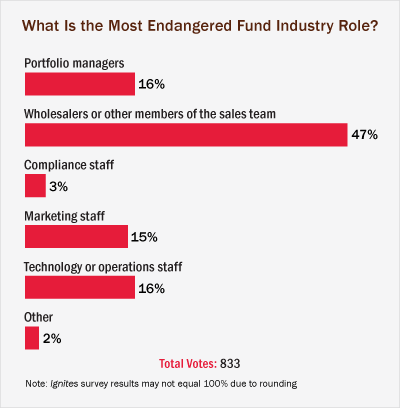
A recent survey of Ignites readers concluded that sales and marketing professionals are quickly headed for extinction due to technology, but is that really the case?

The short answer: No way.

The argument that technology will replace talent is a stretch at best. Sure, technology brings efficiencies, but that’s been happening for the past 100 years. At the end of the day, talent always trumps technology. What was the last great company that had terrific technology, but little or no sales and marketing expertise?

In my work in executive search across the investment industry, I see every day that having top sales and marketing talent on your team has never been more important. If anything, there is a talent shortage for world-class sales and marketing executives, and that dearth of talent is holding back many companies with hockey-stick like revenue plans.

Don’t Call the Undertaker

Rumors about the demise of sales and marketing talent in the investment industry are greatly exaggerated for several reasons.

First, great firms and great teams are the direct result of great people. Think about the impact that Jim Jessee or Carol Geremia have had with their clients at MFS or George Reidel as the Head of Financial Institutions at T. Rowe Price. Clients view sales and marketing executives as the face of the firm, whether in presentations, calls or meetings. Quite often in the investment industry, deals are sold – not bought, or negotiated – not purchased off the rack. Without sales and marketing people, transactions would never get off the ground. Could a cloud-based software platform talk through the objections of a skeptical CFO? Can a piece of technology hold the hand of a nervous Chief Marketing Officer?

Second, the current disintermediation of sales teams isn’t correlated to technology or “machines,” as the survey noted, nor the declining relevance of the sales function. Rather, firms are taking advantage of the current economic environment to top grade their workforce. This usually results in staff reductions of about 10%. For some firms, which realized they’ve over-expanded or over-channelized, cutbacks are designed to realign resources for growth. Some firms, such as Allianz, SSGA and PIMCO, have consolidated their many sales teams into one sales organization. The inevitable result is a duplication in leadership or in sales regions. In the short term, that spells pain in the form of layoffs, but in the long term, the re-allocation of resources translates into growth. Other firms are taking a red line to their most expensive talent, but at the same time, they are cross-training younger, less experienced, less costly sales talent for bigger roles. Whatever the reason, this cyclical or event-driven resource realignment does not spell the end of sales and marketing teams.

Third, the current transformation of sales and marketing roles is a positive reflection of the innovation desperately needed in a maturing industry. In today’s market, there is no room for individuals who aren’t championing new solutions and aren’t willing to adapt to new technology. Old-school sales professionals who aren’t keeping up with technology or have failed to mention that their company’s products or sales processes are outdated should be offered a way out. If you recognize a problem and aren’t part of the solution, you are the problem.

Finally, with regard to marketing professionals, there is simply no substitute for talented people who can identify new markets or new opportunities to deepen or retain relationships. Big data, marketing automation, CRM and other tools can help, but a marketing operation without strategic marketing leaders and supporting staff is a headless horseman. Marketing strategists and product experts see where the puck is headed from a buyer’s standpoint. Then their teams, including channel and digital experts, guide the messaging and product development. Technology is a tool to support marketing talent, not a replacement for it.

The Bottom Line

We have deep respect and admiration for our fellow Ignites readers, but from our vantage point, we’re not seeing the end of marketing and sales professionals as we know it. In fact, we can’t find enough of them to power the growth of companies starved for top-tier talent.

About Kathy Freeman Company

Kathy Freeman Company is a U.S. based strategic advisor to the investment industry and a national, retained, executive search firm. Named a Forbes Top 250 Executive Recruiting Firm in 2018 & 2019.

  • LinkedIn

KATHY FREEMAN COMPANY
805.542.0800


Menu

  • Home
  • Firm
  • Searches
  • Insight
  • Contact

White Papers

  • Talent Trends Report – Asset Management Leadership – January 2024
  • Talent Trends Report – Asset Management Leadership – December 2022
  • Talent Trends Report – Asset Management Leadership - 2021

Recent Blogs

  • Cultivating Talent That Thrives Amid Organizational Change
  • A Growth Mindset: The Ultimate Change Management Tool
  • Progress On Improving DEI, But Challenges Remain
  • Productivity: Its Heightened Importance Today In Asset Management Distribution

Copyright © 2026   Kathy Freeman Company