Kathy Freeman Company | Executive Search | Investment Industry

Executive Search & Human Capital Consulting for Financial Services

  • Home
  • Firm
  • Searches
  • Insight
  • Contact

How to Get More Women on the Boards of Investment Companies

Kathy Freeman Godfrey August 29, 2017


This piece originally ran in Family Wealth Report.

Is it possible that 468 publicly traded companies across America do not have a single woman on their board of directors?

Or that 400 of them failed to address gender diversity in any meaningful way?

In fact, those are the findings from State Street Global Advisors’ recent research on the board makeup of companies they own in their investment portfolios.

As a result of these findings, SSGA initiated a campaign in March to get more women into corporate boardrooms across America. To make the point even further, SSGA voted against the re-election of board directors charged with nominating new directors at 400 companies that it holds. SSGA is also responsible for the installment of the “Fearless Girl” statue directly opposite Wall Street’s iconic bull sculpture.

So why include women in leadership positions?

  • The Peterson Institute for International Economics found that when a company employs women in leadership positions, it can expect to increase profitability.
  • In the companies with the top 20% of financial performance, 27% of leaders are women. Among the bottom 20% of financial performers, only 19% of leaders are women, according to another study.

Accelerating Change

SSGA should be applauded for its efforts. Similar actions should be taken by the investment industry to accelerate its own momentum in diversifying their boardrooms.

According to the Gender Diversity Index by 2020 Women on Boards, the financial services industry is one of only five in which women make up 20% of the boards.

Of the 115 companies surveyed by the organization in 2016, 21.3% of the boards in these financial services were comprised of women. That’s only up from 20.7% in 2015, when 114 companies were surveyed.

While some progress has been made, female board representation in corporate America remains overwhelmingly male. For comparison purposes, almost 47% of the US workforce is female.

This imbalance needs to change. There needs to be a concerted effort, so we offer the following suggestions to move more women onto corporate boards in the investment industry:

  1. Set a mandatory retirement age for board members. Establish retirement guidelines to bring fresh perspectives into the board room. Without a hard-and-fast rule, it’s difficult for one colleague to tell another it is time to retire. A bylaw would eliminate the reluctance to do so.  With the aging of boards across the investment industry, now is an opportune time to institute that change.
  2. Upgrade the quality of the boards. In the past, many firms, especially mutual fund companies, have seeded their boards with friends and family resulting in a cultural vs. competency bias. The growing complexities across the investment industry, along with increased competitive pressure, mandate that directors are armed with a more sophisticated understanding of regulatory requirements and distribution challenges. Conduct an assessment to determine where the holes are in your board and be pointed about strengthening weaknesses with each new member. It’s imperative that each board member possesses unique and complementary skill sets able to provide effective oversight and to support the success of the underlying business.
  3. Fully diversify your board. Board appointments shouldn’t stop with gender diversity. The percentage of minorities on corporate boards has continued to grow slowly. Some groups are making virtually no gains, according to the Alliance for Board Diversity. While a handful of asset management firms have done well in diversifying their boards, there’s ample opportunity for improvement across the industry.

The evidence is clear that diversity is not only the right thing to do, but it is also more profitable in the long run. SSGA and others committed to diversity are absolutely on the right path and deserve our full support.

Talent, Not Technology, Still Carries the Day in the Investment Industry

Kathy Freeman Godfrey July 10, 2017

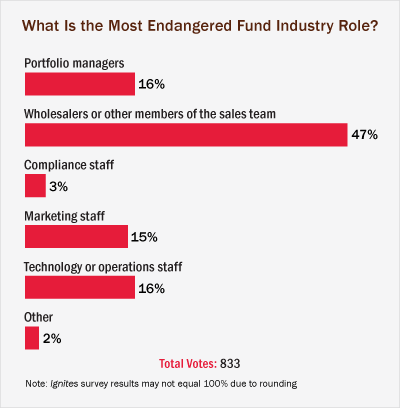
A recent survey of Ignites readers concluded that sales and marketing professionals are quickly headed for extinction due to technology, but is that really the case?

The short answer: No way.

The argument that technology will replace talent is a stretch at best. Sure, technology brings efficiencies, but that’s been happening for the past 100 years. At the end of the day, talent always trumps technology. What was the last great company that had terrific technology, but little or no sales and marketing expertise?

In my work in executive search across the investment industry, I see every day that having top sales and marketing talent on your team has never been more important. If anything, there is a talent shortage for world-class sales and marketing executives, and that dearth of talent is holding back many companies with hockey-stick like revenue plans.

Don’t Call the Undertaker

Rumors about the demise of sales and marketing talent in the investment industry are greatly exaggerated for several reasons.

First, great firms and great teams are the direct result of great people. Think about the impact that Jim Jessee or Carol Geremia have had with their clients at MFS or George Reidel as the Head of Financial Institutions at T. Rowe Price. Clients view sales and marketing executives as the face of the firm, whether in presentations, calls or meetings. Quite often in the investment industry, deals are sold – not bought, or negotiated – not purchased off the rack. Without sales and marketing people, transactions would never get off the ground. Could a cloud-based software platform talk through the objections of a skeptical CFO? Can a piece of technology hold the hand of a nervous Chief Marketing Officer?

Second, the current disintermediation of sales teams isn’t correlated to technology or “machines,” as the survey noted, nor the declining relevance of the sales function. Rather, firms are taking advantage of the current economic environment to top grade their workforce. This usually results in staff reductions of about 10%. For some firms, which realized they’ve over-expanded or over-channelized, cutbacks are designed to realign resources for growth. Some firms, such as Allianz, SSGA and PIMCO, have consolidated their many sales teams into one sales organization. The inevitable result is a duplication in leadership or in sales regions. In the short term, that spells pain in the form of layoffs, but in the long term, the re-allocation of resources translates into growth. Other firms are taking a red line to their most expensive talent, but at the same time, they are cross-training younger, less experienced, less costly sales talent for bigger roles. Whatever the reason, this cyclical or event-driven resource realignment does not spell the end of sales and marketing teams.

Third, the current transformation of sales and marketing roles is a positive reflection of the innovation desperately needed in a maturing industry. In today’s market, there is no room for individuals who aren’t championing new solutions and aren’t willing to adapt to new technology. Old-school sales professionals who aren’t keeping up with technology or have failed to mention that their company’s products or sales processes are outdated should be offered a way out. If you recognize a problem and aren’t part of the solution, you are the problem.

Finally, with regard to marketing professionals, there is simply no substitute for talented people who can identify new markets or new opportunities to deepen or retain relationships. Big data, marketing automation, CRM and other tools can help, but a marketing operation without strategic marketing leaders and supporting staff is a headless horseman. Marketing strategists and product experts see where the puck is headed from a buyer’s standpoint. Then their teams, including channel and digital experts, guide the messaging and product development. Technology is a tool to support marketing talent, not a replacement for it.

The Bottom Line

We have deep respect and admiration for our fellow Ignites readers, but from our vantage point, we’re not seeing the end of marketing and sales professionals as we know it. In fact, we can’t find enough of them to power the growth of companies starved for top-tier talent.

Finding Talent in a Tight Labor Market

Kathy Freeman Godfrey June 8, 2017

This perspective was originally published in Financial Advisor IQ.

It looks like 2017 will be another record year for M&A in the wealth management industry. According to Financial Advisor IQ, the number of deals between RIAs jumped 29% in the first quarter of 2017 compared to a year ago. The deal-making taking place among RIAs isn’t unique in the investment industry. It’s emblematic of a healthy and robust market for everyone in the business.

Why the flurry of transactions?

From my perspective, there are a number of reasons for the activity. First, the selling firms are clearly getting the multiples they want. Second, they are also pairing up to accelerate their growth and to survive by getting bigger. But there is another aspect driving the M&A binge that I routinely encounter in my practice: the scarcity of talent in the investment industry.

Over the past few years, executives have hunkered down in their existing positions. The bull market, coupled with the Trump rally, has led to richer compensation packages and more opportunity in their current role. That’s why the number of executives moving to new positions, as well as those open to considering a new opportunity, are at cyclical lows.

Talent Acquisition En Masse

For firms seeking to grow, M&A is a golden opportunity in one fell swoop to land the next generation of executives and managers. In my discussions with CEOs, talent acquisition is an increasingly important part of their justification for a transaction.

That’s the good news. The bad news is that if the combined organization doesn’t have a clear roadmap for both sets of executives at the time of the deal or shortly thereafter, those folks are likely to consider greener pastures.

To ensure that talent stays put, a newly merged firm should proactively define an executive’s or manager’s career track at the new company. This should include mentoring, professional development or other opportunities that will have a meaningful impact on the future of the combined firm. Doing nothing is a recipe for disaster.

At the same time, it’s important to be cognizant of a deal’s impact on team members who have been patiently waiting for a chance at the C-suite or other senior positions. M&A means this cohort of rising stars must wait even longer. A comprehensive strategy for retaining the best and brightest is spelled out in our 8th annual survey on executive talent in the investment industry, Disruption & Opportunity: Navigating in a Rapidly Changing Market.

Looking for the Spoils

The failure to develop a plan has predictable consequences. These examples from our searches in the past 12 months highlight the dangers.

In one instance, an acquisition to incorporate cutting-edge technology into a leading wealth firm reshuffled the executive suite. When one of the founders was pulled into managing the project integration, the team he was leading was left on their own. Were they productive and self-sufficient without his leadership? Yes. Was there a vacuum created without his leadership that was unaddressed by the firm? Yes, too. The void allowed the team to drift, and the team members eventually left the firm.

In another instance, a merger created the intended scale and operational efficiencies, but it also resulted in a dramatic change in culture. When the CEO didn’t articulate the combined vison of the firm and failed to integrate the two cultures, the uncertainty drove many accomplished executives and managers to entertain other options and ultimately left.

In cases like these, many suitors will be waiting in the wings to scoop up talent. They will be ready to make compelling offers because they realize that M&A is now one of the rare opportunities to land executive talent in today’s tight labor market.

In our experience, the offers are likely to include very attractive compensation, including equity. Suitors will also entice candidates with a host of intangibles, such as a positive corporate culture, a well-defined brand, the flexibility to attend to family matters, and the opportunity to have a meaningful impact on the future of the company. If an employer can make a strong pitch in these areas, compensation will not be the deciding factor.

All of us should be happy that the investment industry is thriving. However, firms that want to win in this market must be smart and aggressive to engage the talent they need for continued growth.

Motivating the Unmotivated in the Investment Industry’s Market for Talent

Kathy Freeman Godfrey May 16, 2016

Now that we are halfway through the 2nd quarter, we thought it would be interesting to compare data collected from our Q1 searches against our Annual Talent Trends Study published in February 2016. We’ve been anticipating that most executives would stay put based on this study’s data from the past two years. While that has been true in 2016, a number of executives are considering a move and our analysis of Q1 searches identified three catalysts that motivated satisfied, highly successful executives in the investment industry’s market for talent.

1) A Terrific Cultural Fit
Approximately 30% of the candidates we presented to our clients were motivated because the position was the right cultural match. Not surprisingly, culture means different things to different candidates and varies from firm to firm in the investment industry. Some thought that culture was a fast-paced, high-growth environment. For others, it meant working in a more established firm with stability and placed a premium on collaboration and mutual respect. Regardless of the definition, it’s critical to articulate what differentiates your firm’s culture from your competitor’s.

2) Opportunity to Have a Big Impact
Approximately 30% of finalist candidates in Q1 searches told us they wanted to have an opportunity to make a bigger impact at their firm. These candidates all expressed a desire to be a critical contributor in driving more revenue, helping a firm enter new markets, or redefining positioning and messaging. The key takeaway for firms seeking to attract talent: How do we make a compelling case that a candidate can have maximum impact at their new firm?

3) Desire For a New Career Challenge
About 40% of our candidates pursued an opportunity because they wanted to enhance their personal brand, move up the career ladder and take on new challenges. Executives defined career challenge as the ability to stretch into new responsibilities, strategically define the direction of the business or a line of business, lead a larger team, or have a seat at table where key decisions are made. How will your firm demonstrate that you can offer them a truly new career challenge?

Q1 Searches - Chart

The Bottom Line
Our 2016 Talent Trends Study emphasized the disconnect between intent and execution as a result of the passivity in the investment industry’s market for talent. Based on our sample pool of candidates presented in Q1 searches, the good news is that highly tenured executives are now considering a move when the opportunity intersects their personal motivation. Nonetheless, they still need a push to get past their complacency. In our view, thinking through these key drivers of culture, impact & career challenge – while sharpening your message and offer – are critical to success in this market.

The Business Case For Corporate Diversity

Kathy Freeman Godfrey April 6, 2016

I was fortunate to be the moderator of a corporate diversity panel discussion recently at MMI’s Sales and Marketing Leadership Forum in Palm Beach. It was an engaging discussion and one that continues to come up in many of my conversations with companies looking for top tier, executive talent. Because diversity remains such a timely and sensitive issue, I wanted to share some thoughts about why improving diversity may be one of the most effective ways for companies in the financial services industry to grow their business.

In my view, the case for diversity is being driven by three overlapping trends across the country:

  1. The percentage of minorities in the U.S. workforce continues to grow rapidly. This is unlikely to change any time soon. The U.S. Census said that in 2012, over 50% of children under one year of age were minorities. Our increasingly diverse population and workforce have a clear preference to work for firms that reflect who they are and the population as a whole. Data from our 7th Annual Executive Survey also confirms the desire for a diverse workforce. While 75% of our survey respondents agreed that a diverse management team arrives at better business decisions, 39% felt like their firms weren’t progressing quickly enough to drive change.
  2. The U.S. consumer is increasingly diverse. Like employees, consumers also want to do business with firms that reflect their cultural heritage and values. Companies that don’t have client-facing employees who mirror the cultural and gender diversity of the country face an uphill battle. Business development is a lot more difficult when a firm doesn’t reflect its customer base.
  3. Financial services remains a male-dominated industry and is overdue for change. While women represent over 50% of college graduates each year, the ratio of women in financial services is fractional. The percentage of women leaders in financial services is even smaller. Today, women need more encouragement to enter the investment industry. Firms also need to figure out how to retain women through their child-rearing years and keep them on a path towards leadership.

What To Do?

The following are four simple corporate diversity ideas that surfaced at the MMI conference. It’s important to note that one of the most important factors in improving corporate diversity requires the support of the executive suite and Board of Directors. Without it, diversity efforts are likely to limp along.

  1. Intentionally recruit women and minorities. It’s interesting how simplistic yet effective some ideas can really be. One of the panelists mentioned a simple shift in mindset from his traditional recruitment of college alumni from the hockey team and instead focused on recruiting from women’s sports or sports with more minority players like soccer or basketball. Clearly a big part of driving success in diversity strategies is intentional pursuit.
  2. Groom qualified men and women of color for leadership positions. Another panelist discussed the effectiveness of pulling women and people of color onto leadership teams through ongoing company mentorship programs. Aligning the interests of minority employees with the company’s priorities through one-on-one integration with a more senior executive is a proven path towards change.
  3. Aggressively recruit Millennials. Data derived from our annual survey highlighted the fact that opportunities are limited for this demographic. One MMI panelist had success in recruiting Millennials by designing a program to encourage them to develop new business efficiencies. A competition was created, teams were chosen, presentations were delivered to the executive leadership team, and winners were guaranteed that their ideas would be implemented. This initiative injected fresh perspective into the company and sent a message that their voices were valued by senior management.
  4. Develop a strategy to keep women engaged through their child rearing years. No conversation about diversity is complete without a discussion about attracting and retaining top-performing women during their child-rearing years. One panelist shared her own personal career success story predicated on how her CEO allowed scheduling flexibility for her to work remotely when her children were small. Another idea was a reduced schedule that allows for a four day work week. Make a point to include the details behind corporate strategies that benefit women in any recruiting conversation where women are involved to show the pathway for engagement and retention over the long term.

The diversity session at MMI was refreshing, and the discussion clarified the need for our industry to do more as quickly as possible. Firms that embrace and lean in to changing cultural dynamics will not only enjoy a competitive advantage, but also will benefit from the satisfaction of knowing the industry is doing the right thing.

  • « Go to Previous Page
  • Go to page 1
  • Interim pages omitted …
  • Go to page 3
  • Go to page 4
  • Go to page 5

About Kathy Freeman Company

Kathy Freeman Company is a U.S. based strategic advisor to the investment industry and a national, retained, executive search firm. Named a Forbes Top 250 Executive Recruiting Firm in 2018 & 2019.

  • LinkedIn

KATHY FREEMAN COMPANY
805.542.0800


Menu

  • Home
  • Firm
  • Searches
  • Insight
  • Contact

White Papers

  • Talent Trends Report – Asset Management Leadership – January 2024
  • Talent Trends Report – Asset Management Leadership – December 2022
  • Talent Trends Report – Asset Management Leadership - 2021

Recent Blogs

  • Cultivating Talent That Thrives Amid Organizational Change
  • A Growth Mindset: The Ultimate Change Management Tool
  • Progress On Improving DEI, But Challenges Remain
  • Productivity: Its Heightened Importance Today In Asset Management Distribution

Copyright © 2026   Kathy Freeman Company